
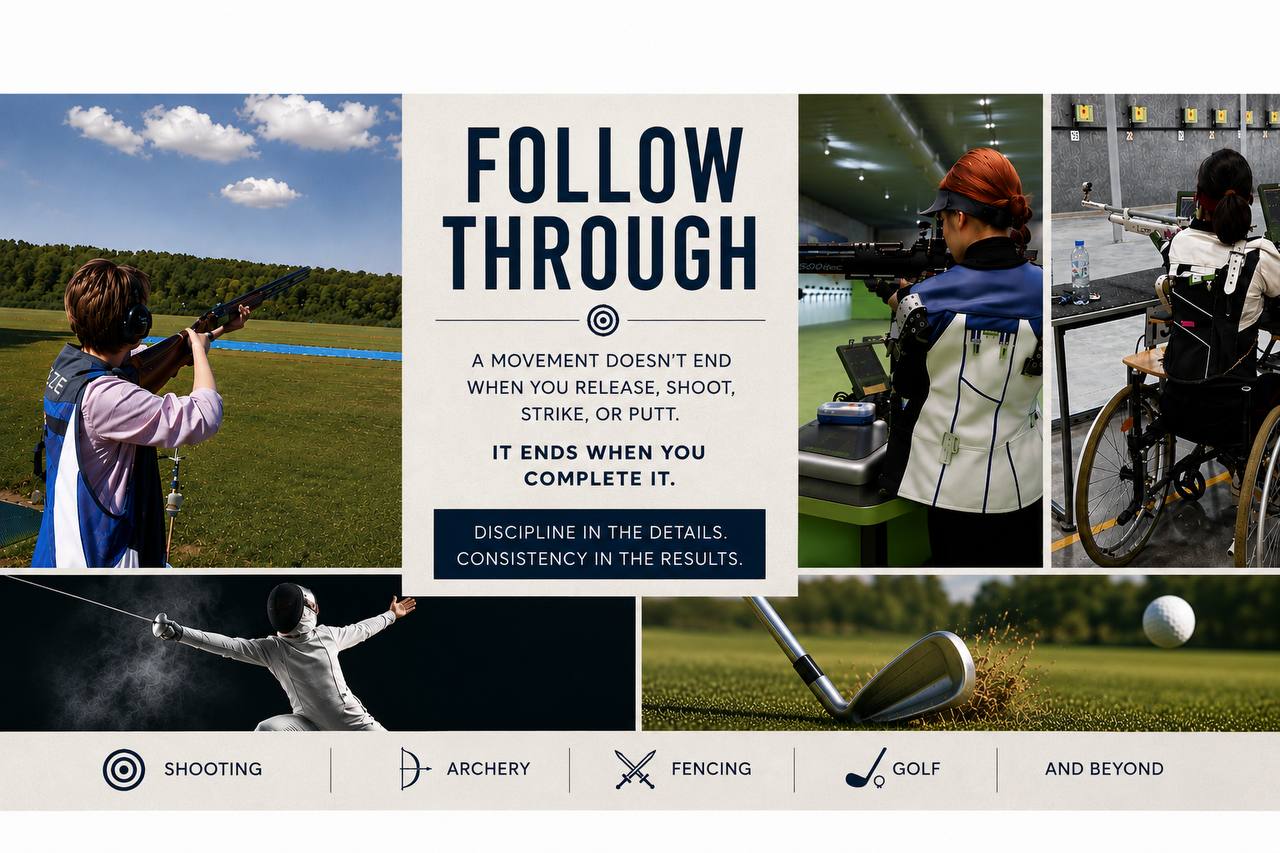
In Paralympic sport, it is easy to focus on diagnosis, classification, body position, adaptive equipment, or movement limitations. All of these are important. But regardless of whether an athlete competes standing, in a wheelchair, with a prosthesis, with support, or using adaptive equipment, the principles of how the nervous system learns remain the same. One of those principles is Follow Through.
Many athletes believe that the movement ends the moment the shot is fired, the arrow leaves the string, the ball leaves the hand, or the stone is released onto the ice. A good coach knows that this is not true. The movement continues even though the outcome can no longer be changed. That is why Follow Through is much more than a technical detail. It is the habit of allowing every movement to reach its natural conclusion.
Prematurely ending a movement can be seen across almost every Paralympic precision sport. A para shooter immediately looks at the monitor. A para archer lifts the head to see the arrow. A boccia player watches the ball before the arm or ramp movement has fully finished. In wheelchair curling, the athlete shifts attention to the stone before the release is complete. A wheelchair billiards player looks toward the balls while the cue is still moving. None of them are trying to make a mistake. They simply want to know the result as quickly as possible.
For many para athletes, however, there is another reason why movement ends too early. Many live every day with chronic pain, muscle weakness, spasticity, tremor, impaired coordination, or increased fatigue. Some must constantly stabilize their bodies in demanding positions. Others overload one side of the body to compensate for limited function on the other. Some experience discomfort from a prosthesis, orthosis, or prolonged sitting position. After a shot, throw, or stroke, there is a completely natural desire to reduce tension, change position, or relax the working muscles as quickly as possible. This is not weakness or poor discipline. It is a normal response of the body. But if it happens before the movement has naturally finished, that response itself begins to become the habit.
The problem is not simply the change in body position. At that moment, the brain is still completing the motor program while attention has already shifted toward evaluating the outcome or escaping discomfort. Instead of reinforcing one complete movement, the nervous system repeatedly reinforces a movement that ends just a little too early. After thousands of repetitions, that becomes part of the athlete’s technique.
The real issue with Follow Through is not that the athlete lowers the arm too soon, changes head position, or relaxes the muscles too early. The problem is that the brain finishes the movement too early. When the athlete is calm, this may hardly be noticeable. But under the pressure of competition, when fatigue increases, pain becomes more noticeable, or muscle tension rises, every small instability becomes more apparent. It may seem as though stress or physical limitations caused the problem. In reality, stress simply reveals what the nervous system has been practicing throughout thousands of training repetitions.
For that reason, Follow Through should never be treated as a skill that matters only before an important competition. It is built every single day in training. Every repetition teaches the brain something. The only question is what it is learning. Is it learning to complete the movement, or to abandon it the moment the athlete wants to see the result or relieve physical discomfort?
For the para athlete, Follow Through becomes more than a technical skill. It becomes part of working with the body every day. Sometimes completing the movement means resisting the urge to relax too early, change position, or reduce pain. That is why good Follow Through requires more than sound technique. It also requires patience, concentration, and respect for the movement itself.The more challenging the athlete’s biomechanics, the more valuable every properly completed movement becomes.
For the para coach, Follow Through is not about asking an athlete to remain still for another second after the shot. It is about determining whether the athlete has completed the entire motor program. If an athlete unloads the muscles too early, changes body position, shifts weight, relaxes stabilizing muscles, or searches for the result before the movement is complete, the coach is seeing more than a technical mistake. They are seeing the exact point where the nervous system stops learning the movement. At the same time, the goal is not to make every athlete look identical. Every para athlete has different physical abilities, different limitations, and different ways of stabilizing the body. The principle, however, remains the same. Every athlete should complete the movement as fully as their individual abilities allow.
The best para coaches know that major problems rarely begin with major mistakes. They begin with small details that remain unnoticed for a long time. Follow Through is one of those details. It is easy to underestimate because it happens after the action seems to be over. Yet this is precisely the moment when the nervous system finishes learning. If the movement is completed properly thousands of times, that becomes the habit. If it is interrupted thousands of times, that becomes the habit instead.
This is one of the defining characteristics of Paralympic sport. Physical limitations may change biomechanics, but they do not change the way the nervous system learns. Every athlete moves differently, but every brain learns through the same fundamental principles. Follow Through is not simply what happens after a shot, throw, or stroke. It is the habit of bringing every movement to its natural completion. Over time, it becomes one of the foundations of consistent performance, allowing athletes to perform not despite their individual challenges, but together with them.