
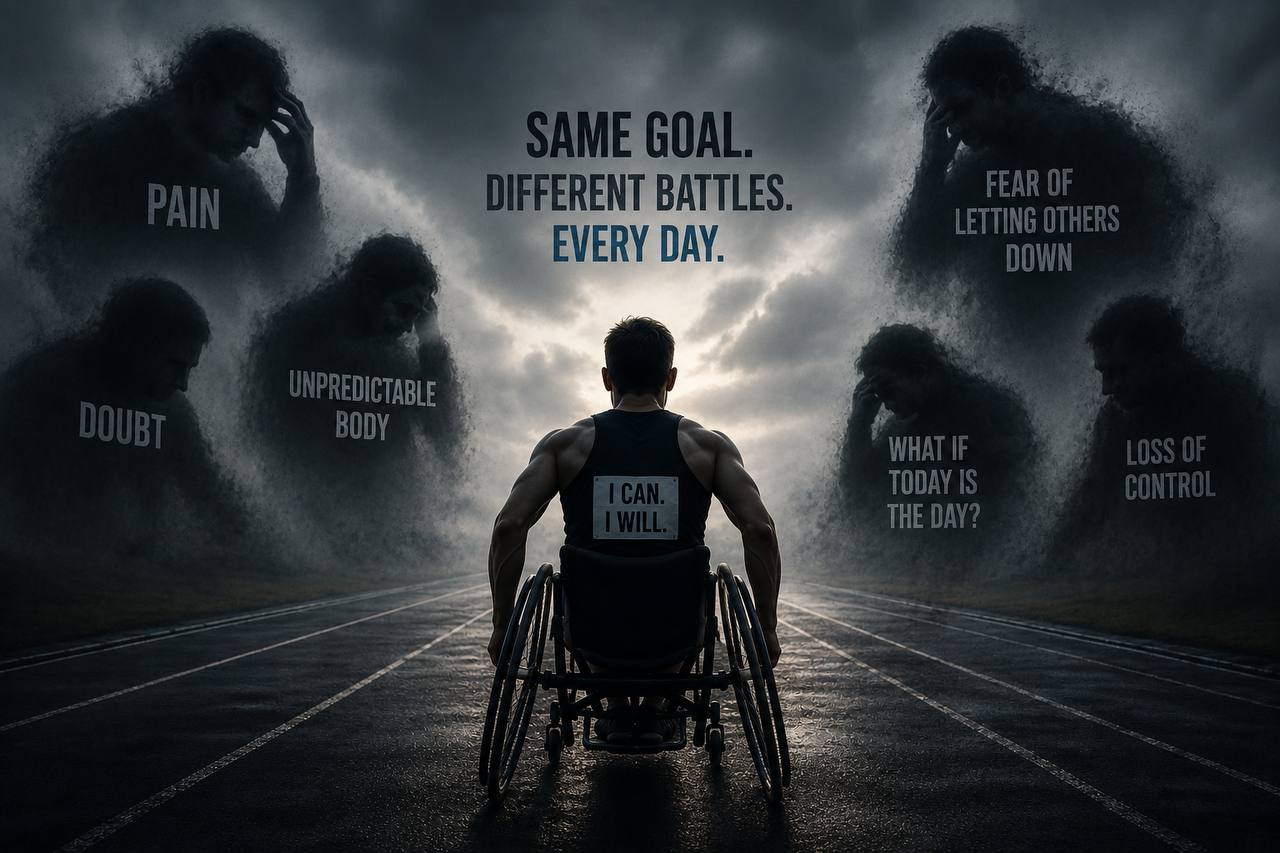
People rarely talk about fear in para sport. We talk about resilience, determination, motivation, and overcoming challenges. But if we are honest, fear is something almost every para athlete knows. The difference is that it is not always the fear of losing. Sometimes it is something much deeper. It is the fear of waking up and realizing that your body feels different today. The pain is stronger. Muscle tone has changed. Fatigue comes earlier. Spasticity has increased. Sensation is different. Sometimes these changes are so subtle that nobody else notices them. But the athlete notices immediately because performance is built on details. That is when a question quietly appears: Will I still be able to do today what felt natural yesterday?
What happens next is almost invisible from the outside. The competition has not started yet, but the real battle already has. Not against an opponent, but inside your own body. Your attention is no longer free. Instead of preparing to perform, you begin checking yourself. How does my arm feel today? Has the pain increased? Is my sensation the same? Has my muscle tone changed? Every unusual feeling starts to look like a warning sign. Gradually, your attention shifts away from the task and toward monitoring your body. The longer this continues, the less attention remains for performance itself. The hardest part is not the possibility of a lower score or a slower time. The hardest part is losing trust in your own body. Yesterday, the movement felt reliable. Today, you are no longer sure you can repeat it.
This is where many athletes begin fighting the wrong battle. They try to get rid of fear, when fear is no longer the real problem. The real problem is that fear slowly takes control of attention. Constantly checking your body does not make it more predictable. It simply leaves less attention for the job that needs to be done. The goal is not to ignore changes. That is impossible. The goal is to notice them, adapt to them, and then return your attention to the task instead of staying trapped in monitoring every sensation. You cannot always choose the condition your body will be in when you step onto the field of play. But you can almost always choose where your attention goes. Toward your doubts or toward your performance. And very often, that choice has a greater influence on the outcome than the physical changes you feared in the first place.